Monday, August 6, 2012

Quester Characters

Last week at work I had a half day group. However I was working at an alternate site, so there was only one other group, which was full day. They asked me almost every day if I could stay with them after my group was done. I finally caved in on Friday and hung out with them for a few hours. I drew them some pictures of their in-game characters. I would wait to edit these once I get my laptop back from the shop, but I promised I would post them for them in a few days. So here they are.
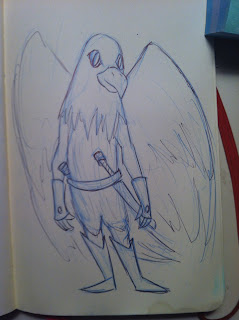
An eagle-man thingy!

Casik's giant squirrel character, alongside his squirrel pets
 An ice spider with a dream essence gladius
 A dragon mage
A warrior with what is supposed to be spider armor. Ha, I have no idea how to draw armor.

Sunday, May 6, 2012

Megas XLR

My final for perspective. The assignment was to draw characters and a setting from one of your favorite cartoons. I picked Megas XLR even though I haven't seen that show in ages. This was stupid because I never draw mechanical things so drawing a giant robot in 3 pt was very difficult. I didn't get an A on this for a completely unspecified reason (I've aced everything else in the class, seriously, it was a waste of time) but I am pretty sure it would be because my composition is so busy. I think this would look better fully colored, but I am faaaar too lazy for that.

Also, I know it totally doesn't make sense they are standing outside the robot when they should be piloting it, but I had to draw the characters. It was stupid because the grid we had to do was only set up for birds eye perspective, but given the nature of giant robots, I knew it'd look better/be easier to draw worms eye. So I had to invent a fake ground plane, and cut characters off at the knees, which kind of ruins the whole aim of the assignment, which was to ground characters on a plane. If that is why I got points off, I'd be pissed, because it was my teachers suggestion anyway.

Final animation- 10 second scene


Goofy, thinking he is super cool, orders a beer at a bar, only to discover that he is a total lightweight.

Inspired by true events... in my own life. o.o

My final project for animation class. I slaved at least 50 hours on this baby, and I'm still not fully happy with it, but I can't stand working on it anymore. I don't think straight up 2d animation is my calling. Too much revision! At one point I had to redraw 50 frames because I got too off model. Ugh. 

Thursday, May 3, 2012

Coraline Cat Walk Cycle


My final for fundamentals of Maya...I modeled, rigged, and animated this all on my own. The only guidance I really had for rigging and animating were the videos on Lynda.com (thank god for those) I basically did everything twice before getting it right. The walk is funky, but I've never even done a 2d two legged walk sooo yea. Obviously I am going to have no idea how the timing for a quadruped works, haha. Anyway, I feel like I accomplished something. It took a lot of work.

Tuesday, May 1, 2012

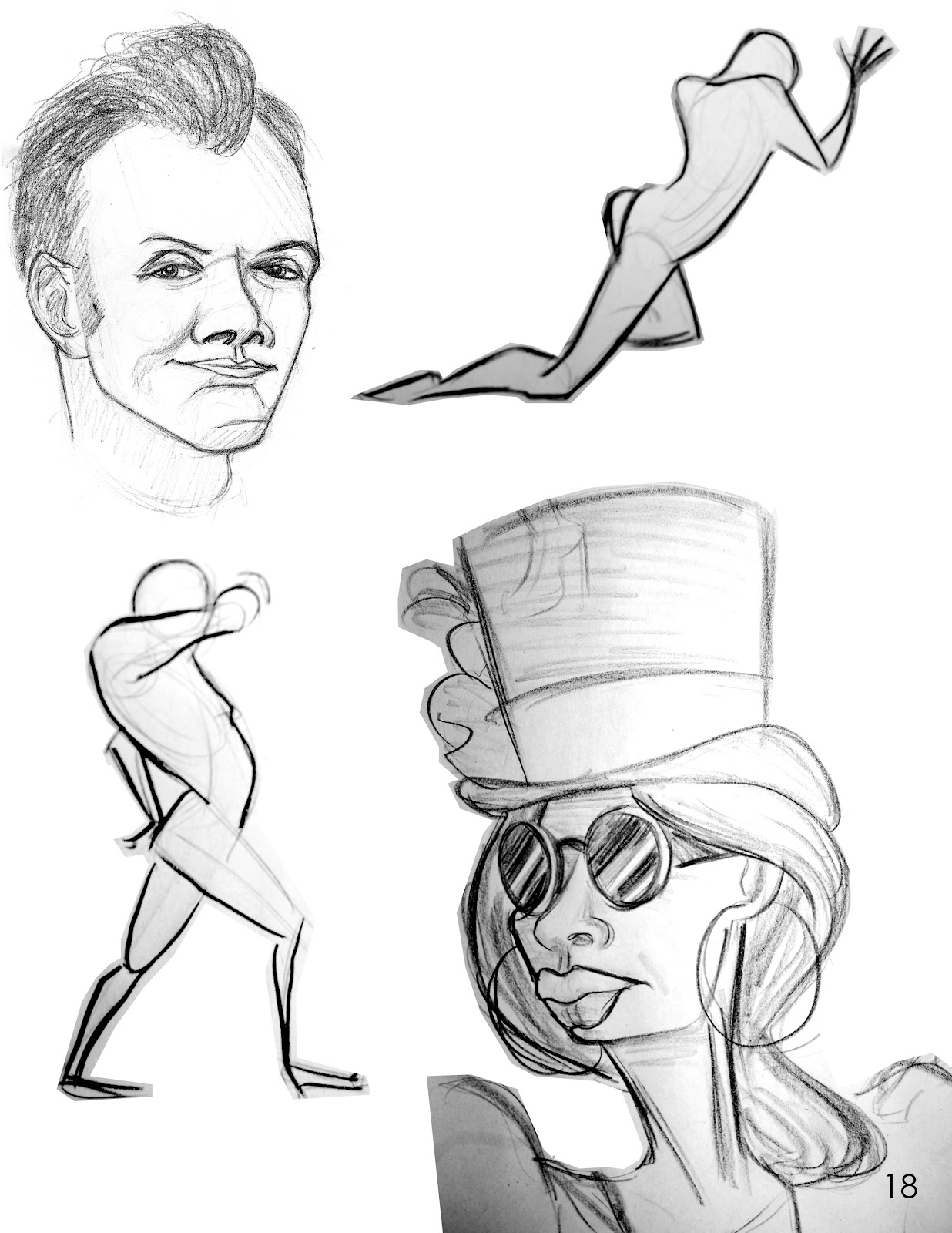
Figure Drawing Portfolio FInal


Our figure drawing final was to put together a 20 page portfolio of our best work from the semester. So here it is. .
..20 pages is a lot o.o Especially when we had zero days to do any exaggerated drawings. Fail.


Saturday, April 7, 2012

Goofy Jump


Hopefully youtube fixes the weirdness of this soon...but here is my most recent animation assignment. Not as proud of this, but whatever.

Tuesday, April 3, 2012

History Comics

 For my western civ project I decided to do a series of comics about Ancient Greece in homage to Kate Beaton's Hark! A Vagrant series. 

It was of course in doing this project did I realize how much I realize I suck at comics. Especially when it comes to type. I don't know the proper kinds to put in through photoshop and my handwriting is just dumb...so yea...I feel like it really detracts from the whole thing overall. Oh well. Hopefully I'll still do alright on this project.

Tales of Athens


Women of Athens in ancient Greece had no independent existence. They were under the wing of whatever man was the authority in her life, either her father, husband, or sometimes even their own sons (Blundell 78). Common women were often illiterate and often seen as important because of the connections their marriages established, both through their dowry and also occasionally serving a role in the transfer and ownership of land if their fathers died and had no other heirs. The only control they had was over the on-goings of their household. All they held ownership was over slaves and some moveable goods (Blundell 92). All men of the day were very against women even so much as leaving the house. Quotes from the likes of Euripides and Plato provide examples of this attitude. Euripides has been quoted to actually say “It is not nice for girls to creep through the crowd,” and “She ought not be seen even standing on the roof of her house.” (Blundell 133) Plato has said that women are “accustomed to an underground and shadowy existence” (Blundell 135). Perhaps these quotes are a little strange out of context and exaggerated in these comics, but nevertheless they serve as a strong demonstration of the rather misogynistic views of the Ancient Greeks in Athens.

Letters From Sparta
In contrast to the women of Athens, women in Sparta during the time of ancient Greece had much more independence. Women of Sparta received an education quite equal to the likes of men. Beyond that, they often did not get married until they were 18, and even then they did not move in with their husbands until much later, often at the age of 30 (Blundell 145). Women even got to take part in processions, ritual dances, and sporting competitions, frequently in the nude (Blundell 152). This incites the question of what the motivation and reasoning of Spartan men to allow this to happen, especially when another major city-state nearby took such opposing views on the matter. Another curious mannerism of the Spartans were the marriage ceremonies and rituals. It was common for women on the marriage night to have their heads shaven and dressed as men. They would meet with their husbands alone in at night and consummate, spending a few hours together before the husband would return to his barracks. This ritual would continue for an extended period of time until the woman moved in with her husband (Blundell 153). The citizens of Sparta were also openly polygamous. They conducted practices of “wife borrowing,” in which men would marry each others wives (Blundell 154). This is a particularly striking custom as it illustrates the very base and simplistic culture of the Spartans. They had no need for complicated laws and social orders in their militaristic city-state.

300 Redux
The true events that took place at the Battle of Thermopylae are quite differing from the pop-culture depictions in movies and graphic novels that most of us are familiar with. While it is common knowledge that 300 Spartans fought against an enormous population of invading Persians, it is often glossed over that anywhere from 4,000 to 7,000 other Greeks were on their side and fighting with them (Herodotus 7.202.1). It is an interesting oversight that this is ignored in modern times, and also perhaps slightly awkward for those who did fight. The Greek army was still known for being very strong, however, and part of the reason the Greeks were so successful in battle was from their military tactic of the phalanx formation—ironically a word very close that of “pharynx,” although the two were probably never mixed up. The phalanx formation was a line of men closely packed together “standing in long, parallel lines, close to each other. Every hoplite carried a large round shield…which covered his own left side and the right side of the man to his left” (Livius.org). Their spears emerged from this impenetrable line of shields, making it a very successful tactic, no doubt used in the Battle of Thermopylae. This is especially in contrast to Persian equipment, which, among other things, actually included wicker shields (Herodotus 7.61.1). It is interesting as well, that today the Persians are depicted in such an intimidating manner, when really their appearance was not far off that of the Greeks, Xerxes being no exception (Hope, 24).


Works Cited
Blundell, Sue. Women in Ancient Greece. Cambridge, MA: Harvard UP, 1995. Print.
"Greece." Livius. Articles on Ancient History. Livius.org. Web. 31 Mar. 2012. .
Herodotus. Herodotus: The Histories. Harmondsworth, Middlesex: Penguin, 1986, 1972. Print.
Hope, Thomas. Costumes of the Greeks and Romans. New York: Dover Publications, 1962. Print.